


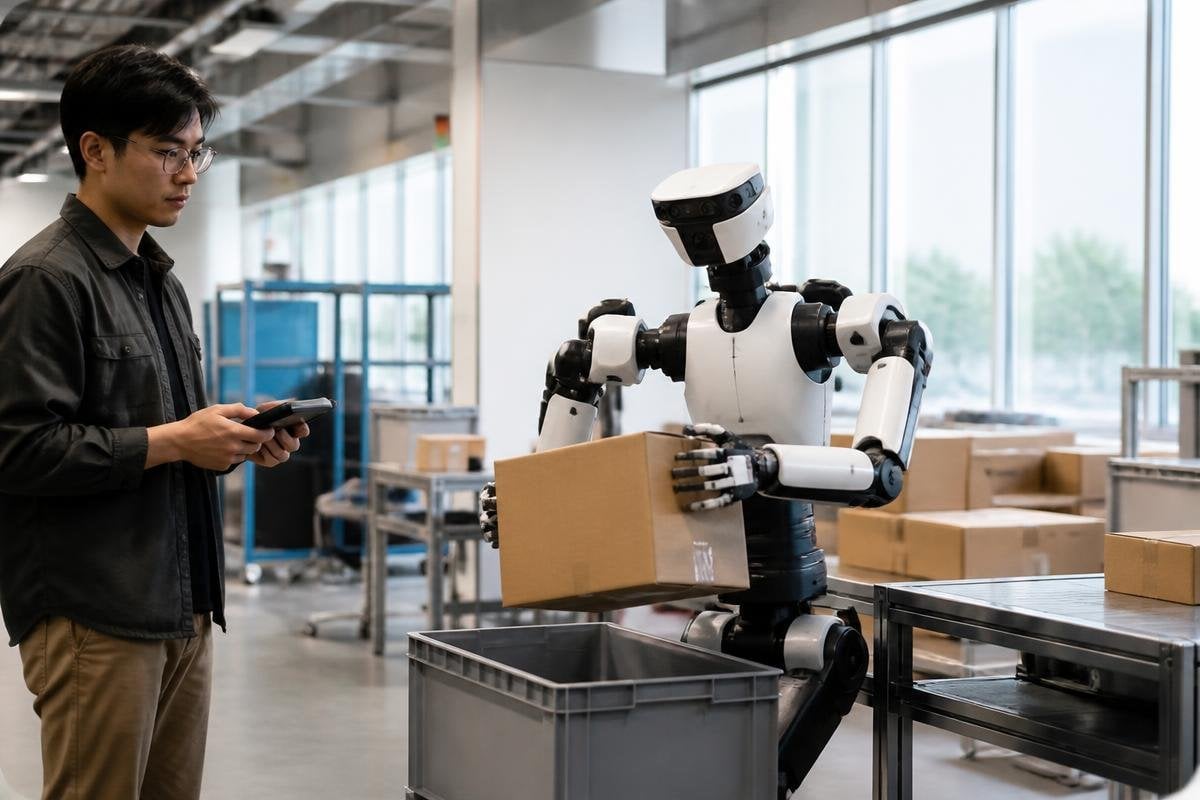
AI can write code, sort images, and answer questions through a screen. A robot has to sense a room, move through it, touch objects, and recover when something shifts. That gap is why the next major test for AI may happen in factories, hospitals, farms, and homes.
- Physical AI must connect software with cameras, motors, and power
- Small errors can damage goods or create safety risks
- Useful systems will be judged by repeatable work, not polished demos
Software meets the real world
A software system works with data that can be copied and checked at low cost. Physical machines work with weight, grip, light, surface shape, battery charge, and space. These details vary by task, even when the job sounds simple.
Picking up a box shows the problem. The robot needs to find the box, estimate its position, choose a grip, move its arm, and check that the box stayed in place. A camera can miss an edge. A motor can move too far. A flexible package can bend under the gripper.
That chain turns a language or vision model into part of a larger machine. The model may suggest an action, but sensors and control software still decide whether the action is safe and possible.
The same issue appears in autonomous vehicles and mobile robots. A map can show where a wall should be, but LiDAR and cameras must detect where the wall is now. The robot then needs enough battery and motor control to stop or change course.
Why the work is harder than a demo
A short demo can prove that a robot completed one task once. It doesn’t prove that the system can repeat the task for hours, handle different objects, or recover after a mistake. Those are the tests that matter to a factory manager or a hospital team.
Physical systems also have costs that software does not carry in the same way. Motors wear out. Batteries need charging. A damaged gripper can stop a work cell. Safety systems may slow the robot when a person enters its working area.
Those costs make physical AI claims harder to judge from software alone. Physical AI reporting from Robot24.com can tie a claim to the machine, work site, and task behind it. That record leads to the practical test: can the robot cover the costs of its body and upkeep?
The strongest case against physical AI is practical. Software can reach many people through an update, but each robot needs a body, a service plan, a safe place to work, and a task that pays for those costs.
I think that physical limit will filter out more weak AI claims than another polished video will.
The useful measure is repeatable work
A robot earns its place by doing a defined job at a steady rate. That job might involve moving parts between stations, carrying supplies, inspecting surfaces, or sorting objects. The task needs a clear result and a way to measure errors.
This changes how companies should judge new systems. Ask how often the robot needs human help. Check what happens when an object is missing or placed at the wrong angle. Record downtime, power use, repair time, and the space needed around the machine.
The answer may still be no. A robot that handles one narrow task for a full shift can be more useful than a general system that performs many tasks only under close supervision.
A practical check before buying
Use these points when a vendor presents a physical AI system:
- Name the task: Write the exact job, object type, work rate, and allowed error.
- Check the setting: Test the lighting, floor, shelves, people, noise, and available space.
- Measure help calls: Count how often a person must reset, guide, or refill the robot.
- Price the full system: Include grippers, sensors, safety equipment, software fees, power, and service.
- Ask about failure: Find out what the robot does when its camera, battery, motor, or network has a problem.
Those checks turn a broad AI promise into a work question. They also show which parts need better sensors, stronger control, or a simpler task design.
The next physical AI systems will prove their value in ordinary work cells and service corridors. Watch the repeat rate, human help calls, and repair cost; those numbers will decide whether the software belongs in a machine.
